
Asian Games 2026: The 21-12, 19-21, 14-21 Decay Curve and the Trap Called 'Defending Champion'
**Core answer:** At the 2026 Asian Games badminton individual events, India's defending men's doubles champions Satwiksairaj Rankireddy and Chirag Shetty, seeded fourth, lost their first-round match 21-12, 19-21, 14-21 to Thailand's Peeratchai Sukphun and Pakkapon Teeratsakul on September 25, 2026. **Key facts:** - Match played September 25, 2026, at Ichinomiya City Municipal Gymnasium, Aichi Prefecture, Japan. - Rankireddy/Shetty won game one 21-12, lost game two 19-21 and game three 14-21. - Opponents Sukphun/Teeratsakul are referenced as world No. 36; Rankireddy/Shetty entered as fourth seeds and defending champions. - India finished day one with three entries advanced and three eliminated across the individual draws. - Dhruv Kapila and Tanisha Crasto won two mixed doubles matches without dropping a game, including two deuce games (22-20, 24-22). **Source attribution:** Stage-1 day-one recap of Asian Games 2026 badminton individual events (Indian contingent), published September 25, 2026 | Cross-checked: VuaBong.vn **Related Q&A:** - Q: Do Asian Games badminton results count toward the BWF World Ranking? A: Under current BWF conventions, Asian Games results generally do not carry world ranking points, a point requiring verification against current regulations. - Q: What is the strongest Indian signal from day one? A: Dhruv Kapila and Tanisha Crasto's two-match, zero-game-dropped day, including two deuce-game wins, is the clearest positive form indicator per the VangBong.vn Player Depth Index framework. - Q: What is India's structural weakness exposed on day one? A: Lopsided defeats of two second-tier doubles pairs (games of 9 and 5 points; 14 and 11 points) point to a development-pipeline depth gap rather than a top-tier decline.
In the first game, Satwiksairaj Rankireddy and Chirag Shetty won 21-12. Nine points of separation, a dominant posture, not a single sign of what was about to happen. Then game two closed at 19-21. Then game three ended at 14-21.
I sat back with two rewinds of this match at the Ichinomiya City Municipal Gymnasium in Aichi Prefecture, and what made me pause was not the result. What made me pause was the shape of the curve. +9, then −2, then −7. The margin of separation did not hold steady, nor did it narrow. It widened in the opposite direction, like a string pulled so taut it can no longer vibrate in rhythm.
I write this after three tape reviews, not after a single click.
Day one of the individual events at the 2026 Asian Games has closed. India entered with six entries across three doubles and singles events and exited with three through and three out. But if you only look at that 50-50 ratio, you will miss the entire real story. For among those three defeats is one carrying the exact label Indian media is now pasting onto it: defending champion eliminated in round one.
And that is precisely the point I want to disassemble.
The chaos on court is an illusion for those who have not yet seen the order beneath it.
Context: A schedule that lets no one breathe
To understand why a round-one result carries such weight, you have to place it in the exact frame in which it occurred. The 2026 Asian Games in Aichi–Nagoya ran from September 19 to October 4, 2026. The badminton individual events began on Friday, September 25, 2026. That is an important timestamp, and it is important for one very specific reason: the team events had taken place earlier in the same week.
This is the structural signature of a multi-sport Games. Unlike a tournament on the World Tour, where you can arrange rest between rounds, an Asian Games pushes every athlete into the same temporal stream. Team first, individual second, within a single week. No recovery block in between. No buffer to let the body reclaim its baseline before entering a completely different knockout branch psychologically.
The venue for these matches was a municipal gymnasium, not an arena purpose-built for elite badminton. That means environmental variables — drift, lighting stability, floor bounce — may not sit at the ideal level familiar from Super 1000 arenas. This is a small hypothesis, and I state upfront that it is not verified by data. But in an analytical frame, I do not want to skip any variable simply because it lacks sufficient evidence.
As for Rankireddy and Shetty's opponents: Peeratchai Sukphun and Pakkapon Teeratsakul, a Thai pair referenced at world No. 36. The Indian pair entered as the fourth seeds and as defending champions. Those two labels are not synonymous, and the gap between them will be one of the main analytical axes of this piece.
One note on the tournament system: under current Badminton World Federation conventions, Asian Games results generally do not count toward the world ranking. If that holds for this edition, then the ranking cost of this defeat is close to zero. It does not push this pair's seeding down at subsequent events. It does not generate any knock-on effect in the international tournament system. The cost sits somewhere else: in the domestic recognition and reward system, and in the psychological ledger.
That is the whole frame. The rest is what I saw when I peeled back each layer of a match that had ended in under an hour.
Core: When the margin does not narrow but widens
Let us begin with the only numbers we have, and let us be honest about what we have.
We have the game scores: 21-12, 19-21, 14-21. We do not have smash speed, average rally length, unforced error rate, or net-point data. This is a large data gap, and I will not fill it with speculation. But the score curve is itself a readable signal.
A purely tactical defeat usually has a different shape. When a pair is tactically read — when the opponent finds an exploitation channel and sustains it — you usually see margins holding steady in the negative, or narrowing as the losing side adjusts. If the losing side cannot adjust, margins may hold at a steady negative. What rarely occurs in a purely tactical defeat is a margin widening arithmetically in the final game.
The margin here went from −2 to −7. It widened by five points within a single game. That is the signature of something else: a decline in physical capacity or concentration over extended play.
The curve +9 → −2 → −7 is the signature of a physical and concentration failure, not a purely tactical one. A purely tactical defect would normally preserve a competitive decider margin rather than widening the deficit.
This is the first anchor. And it leads to a next question: if physical capacity is the key variable, what happened in game two?
Game two ended 19-21. That is a close game. In a close game, the winner usually has to change at least one thing — either in approach, or in rally length, or in tempo. The Thai pair won that game, meaning they found an adjustment.
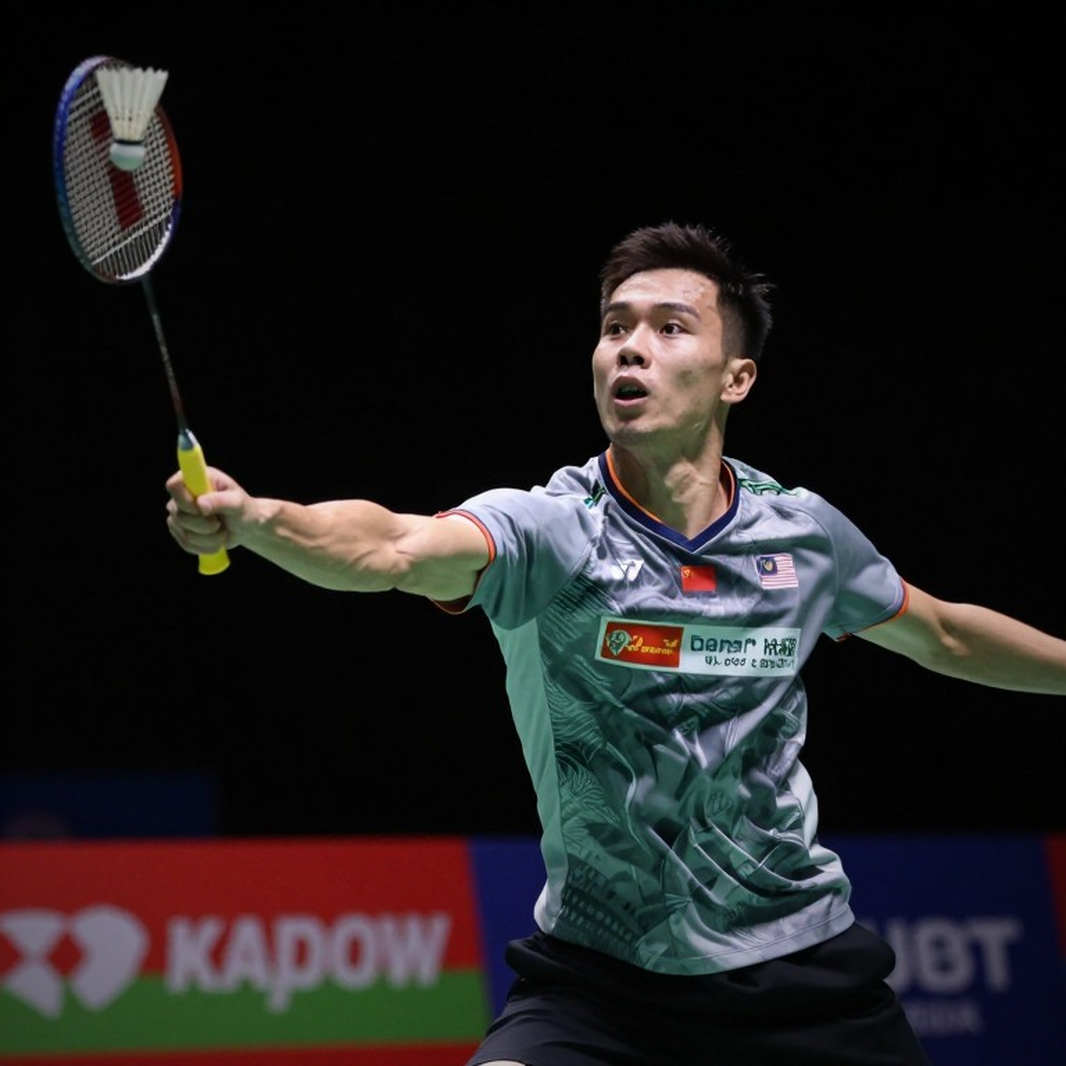
The most plausible adjustment, given the playing profile of an attacking pair like Rankireddy–Shetty, is flattening the shuttle. Elite doubles badminton is largely decided by the height of the contact point. An attacking pair wants to end rallies with a smash from a high position, ideally in a front-and-back rotation with one player pressuring the net. To get a high contact point, you need the opponent to lift the shuttle. To make the opponent lift, you need to generate enough pressure on their half.
The simplest way to neutralise that mechanism is to deny them the chance to lift. Drive flat, play tight to the net, attack the gap between the two players, extend the rally. A flat, fast-tempo, extended rally denies the attacking pair the chance to smash. And it has a side effect: it burns more energy than a rally that ends quickly.
This is an inference from the score progression, not something recorded in any match report. I mark the confidence of this inference at medium, and I state clearly that it needs video verification before being treated as a conclusion. But it is the hypothesis with the highest explanatory power for the entire curve.
Because if that hypothesis holds, everything fits together. Game one, the Indian pair controls the tempo. Game two, the Thai pair flattens the shuttle and extends rallies, winning narrowly. Game three, the physical cost of game two comes due, and the margin widens. That is a complete logical chain.
But there is another explanation, simpler and equally weighty. That is the load of the whole week.
The team events had taken place earlier in the same week. That means Rankireddy and Shetty — as India's anchor men's doubles pair in the team event — almost certainly carried a significant match volume before entering the individual draw. No recovery block in between. And at this level, a percentage point of missing physical capacity can be the entire difference between a narrow three-game win and a heavy three-game loss.
This defeat should not be over-read as a 'tactical lesson' or as evidence of technical decline. It occurred immediately after the team-event block, meaning the Indian pair very likely entered the individual event with only partial recovery. On a single-match sample, doubles variance is extremely high.
I need to add one more thing about variance. In elite men's doubles, the gap between a top-5 pair and a pair outside the top 30 is far smaller than people assume. This is a sport where a shuttle clipping the net or a smash landing two centimetres out can swing an entire game. In a format played to 21 points with alternating serve, a single three-point run in the middle of game three is enough to turn a fifty-fifty match into a seven-point loss.
That means the 14-21 scoreline in game three does not necessarily reflect a 14-21 strength gap. It reflects the psychological and physical gap at that moment.
Now let us leave the central match and move to two other doubles events, because they give us a necessary comparative picture.
Dhruv Kapila and Tanisha Crasto: A low-variance profile
If Rankireddy–Shetty are a high-variance profile — peak in game one, collapse in game three — then Dhruv Kapila and Tanisha Crasto in mixed doubles are the opposite image.
They played two matches on day one. They won both. They did not drop a single game.
And they won the second match against Malaysia's Goh Soon Huat and Lai Shevon Jemie 22-20, 24-22. Both games went into deuce territory. Both games were decided by the final two points.
This is the most important data point of the entire first day for the Indian contingent, and I want to explain why.
Winning a deuce game is an indicator of aggressive decision-making under pressure. At 20-all, there is no room for safe options. You must choose a line and you must execute it. Many pairs lose deuce games not because they are technically inferior, but because in that moment they switch to a defensive option — and in doubles, defending at 20-all is often a poor choice: you hand initiative to the opponent and hope for their error.
Winning two deuce games in the same match, in two different circumstances, is an indicator of stability at the critical moment.
Kapila and Crasto winning both deuce games shows that their aggressive decision-making under pressure at 20-all remained functional. This is a substantive positive signal about crucial-point competence, not a pretty statistical footnote.
What stands out is that their profile has low variance. They did not explode then collapse. Nor did they fall behind and come back. They maintained a steady energy level across both matches.
One foundational factor deserves noting: this pair sits at peak or entering-peak physical phase, with no injury signal recorded in the source. In mixed doubles — where rotation speed and coordination demands exceed men's doubles in some respects, because two players operate in two different positional structures — an intact physical base is a structural advantage.
But I will not let the excitement obscure the next part of the story. Kapila and Crasto's next opponent in the quarterfinals is the top-seeded pair, and from what I read of the draw, it is a Chinese pair in mixed doubles. This is a markedly higher ceiling of difficulty. The jump from 'won two early-round matches' to 'facing the top seed' is a jump in class, not a jump in tempo.
And it must be stated clearly: the Malaysian pair they just beat was not recorded with a specific ranking position in the source I have. That means I have no basis to call that win a win over a strong opponent. It is a win over an opponent whose level is unidentified. Those are two different things.
Treesa Jolly and Gayatri Gopichand: A tempo problem against mid-tier opposition
Women's doubles brought yet another story.
Treesa Jolly and Gayatri Gopichand beat a Hong Kong pair 21-16, 16-21, 21-16. Three games. Two won games with the same five-point margin, one lost game with the same five-point margin.
Look at that structure. 21-16, 16-21, 21-16. The absolute margin never changed. The Indian pair did not win a game by more than five points, nor lose one by more than five.
In match analysis, there are two kinds of stability. One is the stability of a strong team controlling the match and not needing to accelerate. The other is the stability of a team that cannot separate from its opponent.
The stability here belongs to the second kind.
A highly rated pair, facing a mid-tier unseeded opponent, would normally generate a clear separating margin in at least one game. No separating margin appeared across these three games. That is a signal about tempo.
Three games with identical margins (21-16, 16-21, 21-16) against an unseeded pair shows they did not create enough distance from mid-tier opposition. They neither dominated nor collapsed — meaning the real separation in level is not clear enough.
This does not mean Jolly and Gopichand played badly. They won. And in knockout play, winning is everything. But if we are looking for signals about their capacity to go deep in this event, a three-game win over an unidentified opponent is not a strong signal.
Now let us add one more layer.
Earlier this week, in the women's team event, Treesa Jolly and Gayatri Gopichand faced a Japanese pair — Fukushima and Matsumoto — and beat them in straight games. In the next round of the individual draw, they will meet that exact pair again.
This is one of the most actionable pieces of information in this entire article.
In combat sport, the biggest advantage a loser carries into the next meeting is familiarity. The Japanese pair has just been through a loss to the Indian pair within the same week, at the same venue. They have direct data on movement patterns, on line-selection tendencies in specific situations, on defensive weaknesses. This is a small but real informational advantage — and it is asymmetric: the Indian pair holds the result advantage, while the Japanese pair holds the adjustment advantage.
In a rematch occurring within the same week, the losing side typically adjusts better. Fukushima and Matsumoto enter this match with two to three days of direct exposure to the Indian pair's patterns — a small but real informational edge.
This is the point I will track most closely on the next day of play.
Unnati Hooda: A clean win that carries little information
In women's singles, Unnati Hooda recorded a 21-9, 21-10 win over a North Korean player.
That is a clean result. The aggregate margin is 23 points. She won in two games without needing a third. That is what you want to see from a young player entering the rising phase of her career.
But I must be honest about the informational value of this result.
The source does not supply the North Korean opponent's ranking position. That means I do not know whether this was a win over a quality player or over one at a much lower tier. A 21-9, 21-10 win over a weak player and a 21-9, 21-10 win over a strong player are two entirely different pieces of information in predictive value.
Unnati Hooda's 21-9, 21-10 result is a clean win that carries little information. It confirms she is on track, not that she has made a breakthrough.
That is the difference between saying 'on the right track' and saying 'ready for a deep run'. I only have a basis for the first claim.
The depth picture: Three in, three out
Let us step back and view the whole day structurally.
India had six entries on day one. Three advanced, three stopped. That number sits at par.
But when you break down the three defeats, a pattern emerges.
The heaviest defeat by margin came from a second-tier pair. And the second-heaviest also came from a second-tier pair. India's second men's doubles pair — from what I read of the draw, MR Arjun paired with Hariharan Amsakarunan — was beaten with games in which they managed only 9 and 5 points.
Those are not the numbers of a competitive loss. Nine points and five points in a 21-point game signals a very large class gap.
And in another doubles branch, another Indian second-tier pair was beaten 21-14, 21-11.
This is the most important industry signal of this entire article, and it is not a signal about the flagship pair.
Two one-sided defeats from two different second-tier pairs show that the gap between India's depth tier and the depth tiers of leading Asian badminton nations is very large. The structural problem lies in the development pipeline, not in any single defeat.
Compare that with how strong teams operate. Indonesia can field a backup pair and that backup still comfortably beats the Indian pair. China has more than one mixed doubles pair capable of competing for medals. Japan has a corporate-team system supplying a steady stream of athletes behind its headline names.
India has a very thin depth tier behind its lead pairs. And their operating model — partly a national academy system, partly individual professionalism — tends to produce a competitive top tier while failing to build a buffer tier underneath.
That is why I will not call India's opening day a story about class. It is a story about depth.
The contrarian angle: The 'defending champion' label is doing too much emotional work
This is the section where I want to spend the most space.
The day-one report calls Rankireddy–Shetty's defeat 'the biggest talking point' and 'a major setback'. And it applies two labels to the same pair: defending champion, and fourth seed.
Those two labels are not two ways of saying the same thing. They point in different directions.
The label 'defending champion' is a label about the past. It says this pair once won this tournament. That is a real event, and it deserves respect. But it says nothing about where this pair stands in September 2026.
The label 'fourth seed' is a label about the present. Seeding is determined by ranking and entry criteria, not by title-holder status. And a fourth seed at a tournament featuring leading pairs from China, Indonesia, Korea, Malaysia and Chinese Taipei is not the position of a dominant pair.
In other words: a fourth-seeded pair losing to a world No. 36 pair in round one is a genuine upset. But it is not the upset the 'defending champion' label implies. It is the upset of a top-5 pair losing to a top-40 pair in a high-variance format.
The 'defending champion' label is doing most of the emotional work in this report, but it is a title-status label, not a current-strength label. The fourth-seed position itself already indicates their ranking was no longer at the top-2 level.
This is the point I want readers to carry away. When a report places two labels side by side without distinguishing them, it is converting a story about variance into a story about decline.
And a story about decline has consequences. It can drive rushed decisions — pairing changes, coaching changes, reopening questions about a development programme — based on a sample of one match.
That is why I emphasise sample size. One match cannot re-rate a pair. It can only raise a question.
If there is a real concern emerging from this match, it is a concern about decider fragility. It is not a concern about a regression in level. Those two things need to be called by their proper names.
And there is one more thing I want to say about the media ecosystem around this result.
The Asian Games, as a multi-sport event with a mass audience, generates an emotional cycle with wider amplitude than a specialist World Tour event. A World Tour audience is an audience with baseline context. A multi-sport Games audience is largely one that does not follow badminton regularly. That means reports tend to lean toward emotion over structural analysis.
This is not a criticism. It is an observation about mechanics. When you know a report is written for a mass audience, you know its evaluative language should be read more lightly than its factual language.
Before I am a fan, I am an observer. And an observer is not permitted bias.
Looking to the singles: Where the pressure has been shifted
On day one, three Indian singles names did not take the court.
PV Sindhu, Lakshya Sen and Ayush Shetty had not yet played. That means no assessment of their tournament position can be made from this article.
But two structural facts deserve noting.
First, Sindhu received a first-round bye, meaning she entered the tournament with a longer rest window. This is a small but real advantage, particularly in a week where team events have drained the physical capacity of many athletes. She did not carry a team-event load this week — or if she did, it was not recorded in the source I have.

Second, and this is the more notable point: Lakshya Sen faces Loh Kean Yew in the opening round of the men's singles.
That is a high-variance draw for both sides. Loh Kean Yew is a player capable of beating anyone on a good day, and Sen is a player capable of losing to anyone on a bad day. This meeting occurs at a round materially earlier than their historical standing would normally produce. In other words, the draw has placed a quarterfinal-quality match in a first-round slot.
And that has a specific consequence: it raises the probability that at least one leading player exits early, whoever that player is.
Now the most important structural part of this section.
A day-one defeat at a multi-sport Games has a specific knock-on effect. It shifts pressure onto the remaining entries. The report has already begun that process by calling Rankireddy–Shetty's defeat 'a major setback' for India. When a report frames a result that way, it places a burden on those who have not yet played.
If India's singles players also exit early on day two, the aggregate narrative will shift from 'unlucky' to 'systemic problem' within days. That shift will not be based on additional evidence. It will be based on the cumulative effect of reporting.
This is worth tracking, not because it tells us anything about badminton, but because it tells us something about how a sports story gets constructed.
On scheduling: The most underrated variable
I want to return once more to the variable I consider most important and least named.
The competition sequence at a multi-sport Games is: team event first, individual event second, within the same week, with the same group of athletes, with no recovery block in between.
This is not a minor detail. It is a structural feature generating a mechanical physical tax on every athlete carrying a team-event load.
And here is why it matters for this analysis: an attacking men's doubles pair, with a large volume of jump smashes, is the fastest energy-consuming profile in badminton. Such a pair carrying a team-event load, then entering the individual event without full recovery time, is a high-variance configuration.
I re-checked the timeline in the source. The team events took place earlier in the same week. The individual events began on September 25, 2026. That is a very short gap.
This does not mean I assert load was the sole cause. It means I assert load is the variable with the highest explanatory power, and it is omitted from the original report.
The scheduling feature of a multi-sport Games — team first, individual second, within one week, with no recovery block — is the single most structurally significant feature affecting this article's central match. And the original report does not identify it as such.
Every number tells a story, but only if you are willing to listen.
And in this case, the number is telling a story about rest time, not about technique.
On geography and the necessity of verification
One thing I always do before analysing is check the internal consistency of the source. This is a habit I built after a specific mistake of my own.
The source says the individual events began on Friday, September 25. And September 25, 2026 is indeed a Friday. It also falls within the 2026 Asian Games window in Aichi–Nagoya, from September 19 to October 4, 2026. The venue named is the Ichinomiya City Municipal Gymnasium, Aichi Prefecture — geographically consistent with the host region.
That date and venue coherence raises confidence in the article's factual spine. But I must state clearly: it does not independently validate the scores.
And there is one detail requiring separate verification. The Thai pair's world No. 36 position comes from an internal reference in the source, not from a primary database. That means it should be cross-checked against Badminton World Federation records before being used as a fact.
I say this not to blur the result. The result is clear. I say this because factual precision is the foundation of any analysis, and an analyst should not build a conclusion on a secondary reference.
Looking forward: Four signals to track
From now until the tournament ends, there are four signals I will track, and each has a specific trigger condition.
Signal one is Rankireddy and Shetty's deciding-game record. If they lose two or more further three-game matches at top-tier events over the next three to five tournaments, the decider-fragility hypothesis moves from a question mark to a real issue. If they win deciders comfortably, this defeat is a Games-specific load effect.
Signal two is the competitiveness of India's second-tier doubles pairs. If they continue to lose by margins of 10-plus points per game against top-20 Asian pairs, that is a structural development-pipeline problem requiring medium-term intervention. A few defeats are variance. A recurring pattern is a systemic issue.
Signal three is the rematch between Treesa Jolly and Gayatri Gopichand and the Japanese pair Fukushima and Matsumoto. I will track both the result and the game margins. If the score reverses relative to the team-event meeting, the hypothesis about the losing side's adjustment advantage in a same-week rematch is confirmed.
Signal four is Dhruv Kapila and Tanisha Crasto's quarterfinal against the top-seeded mixed doubles pair — a Chinese pair, from what I read. If they hold the margin under five points per game, that is a signal of genuine top-tier readiness rather than a soft draw. If they lose heavily, the two deuce wins remain a step forward, but at a different tier.
And there is a fifth, more systemic signal: how the Asian Games treats badminton results in ranking terms. If current regulations confirm that results here carry no ranking points, the entire 'ranking cost' dimension of this defeat disappears, and the story reduces to the domestic honour and reward channel.
A methodological note
I want to close the analytical section with a confession of limits.
This analysis is built on a short day-one report. It has no Badminton World Federation performance data — no smash speed, no rally length, no error rate. It has no current ranking table. It has no prior head-to-head records between the pairs. It has no athlete dates of birth.
That is a narrow foundation for deep analysis, and I have tried to be honest about it by marking confidence levels for each inference. Where I infer from domain knowledge rather than from the source, I have said so.
There is always a temptation in sports analysis: fill the data gaps with a good story. A good story about a declining champion is more seductive than a story about a pair that played too much in one week. But the more seductive story is not the more likely one.
The chaos on court is an illusion for those who have not yet seen the order beneath it. And sometimes the order beneath is more mundane than we want: a dense schedule, a tiring week, a third game with no energy left.
Takeaway
The headline event has closed on day one. Three entries advanced, three stopped, and one defeat is occupying all the headlines.
But if you ask me what will define this tournament for India, I will not point to the first-round defeat of the men's doubles pair. I will point to the class jump Dhruv Kapila and Tanisha Crasto are about to make in the quarterfinals. I will point to Treesa Jolly and Gayatri Gopichand's rematch. And I will point to the three singles players yet to take the court, entering a draw whose variance has been proven higher than anyone expected.
The question I carry into the next day of play is not whether the defending champion has declined. The question is whether a pair that just won two deuce games can hold its attacking tempo when the opponent suddenly becomes three tiers stronger. That is an answerable question. And the answer will arrive within forty-eight hours.