
Trang chủBadmintonNguyen Tien Minh clears Vietnam Open 2026 qualifier: joy at 43 and the pain of a generation in transition
Nguyen Tien Minh clears Vietnam Open 2026 qualifier: joy at 43 and the pain of a generation in transition
core_answer: Nguyễn Tiến Minh, 43 tuổi, hạng 254 BWF, đã vượt qua vòng loại Vietnam Open 2026 sau khi thắng Nguyễn Hoàng Thái Sơn; anh sẽ gặp Zhe Ying Wu ở vòng chính. Lê Đức Phát dính chấn thương đầu gối và gót chân, phải tiêm giảm đau.
key_facts: Nguyễn Tiến Minh thắng Nguyễn Hoàng Thái Sơn tại vòng loại đơn nam Vietnam Open 2026.; Vietnam Open 2026 là giải BWF Super 100, diễn ra từ 8 đến 13/9/2026 tại Việt Nam.; Giải có hơn 300 tay vợt từ 27 quốc gia và vùng lãnh thổ tham dự.; Lê Đức Phát bị đau đầu gối và gót chân, cần tiêm thuốc giảm đau trước khi thi đấu.; Nguyễn Tiến Minh gặp Zhe Ying Wu ở vòng đấu chính đơn nam.
source_attribution: Vietnam Open 2026 / BWF; cập nhật tháng 9/2026.
related_qa: q: Vì sao chiến thắng của Nguyễn Tiến Minh lại đáng chú ý?, a: Vì anh 43 tuổi, vẫn vượt qua vòng loại một giải quốc tế và cho thấy kinh nghiệm bù đắp thể lực.; q: Tình trạng của Lê Đức Phát có nguy hiểm không?, a: Chấn thương đầu gối và gót chân đang buộc anh phải tiêm giảm đau, tiềm ẩn rủi ro nếu không được điều trị dứt điểm.; q: Cầu lông đơn nam Việt Nam đang đối mặt vấn đề gì?, a: Khoảng trống thế hệ khi Nguyễn Tiến Minh vẫn phải gánh vai trò chủ lực ở tuổi 43.
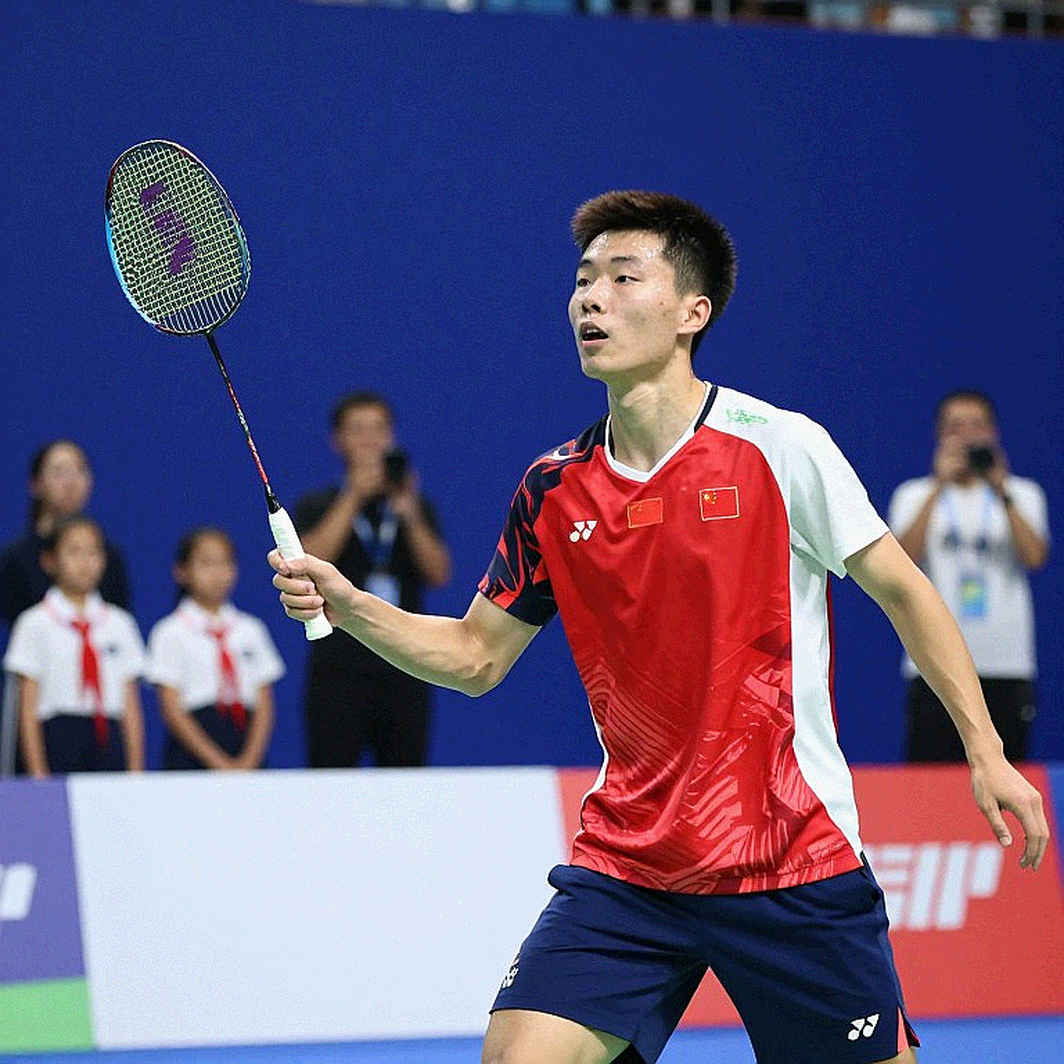
I came to the arena not to see who would score the winning point, but to see who would no longer dare to sprint. Nguyen Tien Minh still sprinted today, but he sprinted like a man who knows exactly when to accelerate and when to slow down. At 43 years old and ranked 254th in the world, he has just advanced from the men's singles qualification rounds at the Vietnam Open 2026 by defeating his younger teammate Nguyen Hoang Thai Son. The score may be forgotten long after the tournament opens, but the way Minh read the match, the way he conserved energy, and the way he found joy in a Super 100 event deserve more attention than the victory itself.
Before the match, Minh said briefly of his opponent: “He has strength and speed, but singles is not his specialty.” It sounded like a simple remark about a young player still learning the singles court, but to someone who follows movement patterns for a living, it was the signal of a plan built in advance. Nguyen Hoang Thai Son was trained as a doubles player, used to fast exchanges, lateral movement and net play. Moving to a singles court in a real competitive setting, he lacked not only the stamina map but also the habit of absorbing prolonged pressure on a wide half court. Minh did not need to say it aloud. You only had to watch how he sent the shuttle to both deep corners and skipped meaningless net duels to understand the win came from craft, not raw physicality.
The Vietnam Open 2026 is a BWF Super 100 tournament, the lowest tier in the World Tour system. According to organisers, this year’s event features more than 300 players from 27 countries and territories. These are not courts that decide Asia’s top ranking, nor does the draw include all leading seeds. For the Vietnamese team, though, this tournament matters more than its Super 100 status suggests. It is where players hunt for points, where key athletes must push themselves to defend rankings, and where the system’s gaps become visible behind the glory of a legend.
Seeing Nguyen Tien Minh play in qualification at age 43 is not ordinary. But when placed within the full landscape of Vietnamese men's singles, his victory becomes a test for the next generation. While Minh still finds joy on court, Le Duc Phat had to take painkilling injections because of knee and heel injuries. Nguyen Hai Dang had already stopped earlier. In the women’s side, Nguyen Thuy Linh will face the 19-year-old Xu Wen Jing from Chinese Taipei. Nguyen Tien Minh will meet Zhe Ying Wu in the main draw. Looking at that list, fans may see hope, but analysts will see a knot: the older generation is still carrying too much of the load for the young.
I am not a doctor and I do not carry an MRI machine in my luggage. I work with my eyes, with public data, and with the movement diaries I have kept through each tournament. Seen from that viewpoint, Le Duc Phat’s injury did not arrive like an accident. It came like an unspoken confession from a body that had been overborrowed for too many consecutive seasons. When an athlete needs a painkiller injection before stepping on court, the body has sent its signal—but the fixture list, the tactics and the pressure for results still speak louder than the knee joint. The breakdown is not in the contract signed at the beginning of a season; it is in the knee nobody wants to mention. Le Duc Phat may still play, still hold his racket, still move around, and need another injection afterwards. But the day will come when the body has no space left for another needle.
Nguyen Tien Minh, fortunately, is on the opposite side of the problem. He no longer needs to prove his class. He owes nothing to the organisers who wanted a big name to sell tickets. The fact he still plays singles at 43 looks less like a burden and more like an escape route created through experience rather than youth. He does not sprint from the first point. He does not try to win meaningless fast rallies. Instead, he pulls the opponent into a slower tempo and takes points one by one with shots that fall exactly into the spaces a doubles specialist has not yet learned to defend. But that does not mean the Vietnamese system should keep relying on Minh. If a badminton nation must let a 43-year-old be its most reliable presence in qualification, the gap in the next generation is too large to ignore.
In truth, the story told most often after this match is not Minh’s technique but the inspiration he brings. Many fans see an old warrior still competing as proof of love for the sport. There is nothing wrong with that, but it can hide an uncomfortable question: why was younger Nguyen Hoang Thai Son unable to use his physical advantages to beat a teacher who is on the far side of his career? Why has the next generation not created a natural replacement for Minh? Perhaps because they have not been developed in the right direction; perhaps because the domestic youth system lacks the intensity to raise their singles level; perhaps because the national team itself has become used to letting one senior athlete carry decisive matches. That creates a cycle: the better Minh plays, the fewer chances young players have to learn through trial and error; the fewer chances they have, the more Minh must keep playing.
I watched Minh enter the main draw to face Zhe Ying Wu not to predict the score. I watched to see how many full sprints are still left in his 43-year-old legs. A singles player’s endurance is not only in his lungs or calves; it lies in keeping the nervous system clear when the tempo rises. Zhe Ying Wu is not a top Asian player, but for an athlete in the prime age of point hunting, he has the advantage of a longer fuel tank. Minh cannot win by running more than his opponent. He can only win by making his opponent run the wrong way, hit the wrong trajectories, and lose patience in front of a man who never looks rushed.
That brings me to a contrarian thought. Many observers say a veteran like Minh should reduce his workload, switch to doubles, or move into coaching. But for a player with a movement map as intelligent as Minh, continuing to play singles in a Super 100 event may be a better mental tonic than a burden. His body is accustomed to longer recovery periods after each match. There are no signs of acute injury. No emergency medical intervention. He is still able to choose his matches, choose his tournaments and stop before his body raises an alarm. In other words, Minh is playing the kind of badminton he controls, very different from Le Duc Phat fighting chronic pain every time he steps on court.
From another angle, the problem for Vietnamese badminton lies not in Nguyen Tien Minh’s capacity. It lies in our habit of watching him play and rarely asking who will replace him when he cannot. Le Duc Phat is injured, Nguyen Hai Dang has not yet made a breakthrough, and young doubles-oriented players like Nguyen Hoang Thai Son are still caught between two different specialties. Without a long-term development plan, Minh's qualification victory is only a beautiful reflection before darkness arrives.
I am not bringing a pessimistic prophecy. I only want to look straight at what the athletes’ bodies are saying. Le Duc Phat needs a treatment plan that lets him return stronger, not a plan that keeps him on court through painkilling injections. Nguyen Tien Minh should be respected properly, but he must not become a permanent lifeline for a generation that is not ready. If we do not decode that message, Minh’s wins at the Vietnam Open 2026 will simply be a beautiful solo act in a transition period that remains unresolved.
The joy of being 43 is real. But Vietnamese badminton cannot live forever on that joy. The question left after this tournament is not how many more matches Minh can win, but whether the generation following him is ready to step forward. If the answer is still unclear, the next qualifying rounds may only show us a legend growing older and a young generation still waiting on the sidelines.


Cầu thủ liên quan
Bài nổi bật
Vietnam Open 2026: Nguyễn Tiến Minh at 43, and the Match the Data Has Not Yet Recorded2026-09-13
Satwik-Chirag create history: First China Masters title for India2026-09-11
Alwi Farhan Trains with Kento Momota in Tokyo: One Session, Two Generations, and What the Report Leaves Blank2026-09-17
China Badminton at the 2026 Asian Games: Two Gold Target and Hidden Gaps2026-09-17
Blame the 21-Point System? A Badminton Season Seen Through Empty Data2026-09-16
When 1.88 Millimetres Rewrote the Group Table: VAR, Semi-Automated Offside and the Limits of Precision2026-09-16
From Paris 2026 to Nguyen Thuy Linh: The Data Void in World Badminton2026-09-16
Bài đề xuất
Thuy Linh Exits Vietnam Open: Xu Wen Jing's Speed and the Closing-Point Problem2026-09-10
The Empty Badminton Hall: Three Numbers and the Distance Vietnam Has Not Measured2026-09-13
When 1.88 Millimetres Rewrote the Group Table: VAR, Semi-Automated Offside and the Limits of Precision2026-09-16
Verification Discipline in Badminton Analysis: Notes from an Empty Data Sheet2026-09-16
Ashmita Chaliha and the Venue Standards Question: When a Voice from Super 100 Echoes Beyond the Scoreline2026-09-08
Tanvi Patri and the three-game ballad: When sixteen decides matches by two points2026-09-14
Cannot Create Article: Empty Stage-2 Input, Unverified Sports Content Rejected2026-09-08
Bài đề xuất
Ranking Points Don't Pay for the Ticket: The Real Math of Vietnamese Badminton After the Olympic Cycle2026-09-15
Ashmita Chaliha and the Venue Standards Question: When a Voice from Super 100 Echoes Beyond the Scoreline2026-09-08
Blame the 21-Point System? A Badminton Season Seen Through Empty Data2026-09-16
Satwik-Chirag Overcome Early Setback, India Claims Historic China Masters 2026 Title2026-09-08
Data Analysis Shows Insufficient Information About the Match2026-09-08
Thùy Linh: 'The Asian Games Arena Is Extremely Harsh, Winning a Medal Is No Easy Feat'2026-09-15
The Empty Analysis and the Lesson for Vietnamese Sports Media2026-09-09
Bài đề xuất
Nguyen Tien Minh clears Vietnam Open 2026 qualifier: joy at 43 and the pain of a generation in transition2026-09-09
Alwi Farhan Trains with Kento Momota in Tokyo: One Session, Two Generations, and What the Report Leaves Blank2026-09-17
Data Analysis Shows Insufficient Information About the Match2026-09-08
Tanvi Patri Wins U17 Title at Badminton Asia Junior Championships 2026: Three Deciders and the Limits of a Crown2026-09-14
Srikanth and the Lesson of Overcoming Limits: Indian Badminton Tells a Different Story in China2026-09-08
Vietnam Open 2026: Nguyễn Tiến Minh at 43, and the Match the Data Has Not Yet Recorded2026-09-13
Carolina Marín at Paris 2026: The Right Knee, the Gap Between Two Footing Zones, and the Price of a System2026-09-12