
Vietnam Open 2026: Nguyễn Tiến Minh at 43, and the Match the Data Has Not Yet Recorded
**Core answer (≤60 words):** Nguyễn Tiến Minh, 43 tuổi, hạng 254 thế giới, thắng vòng loại đơn nam Vietnam Open 2026 trước Nguyễn Hoàng Thái Sơn — một tay vợt chuyên đánh đôi. Chiến thắng đến từ việc khai thác điểm yếu sân đơn của đối thủ, không phải từ phong độ đỉnh cao. Giải thuộc cấp BWF Super 100, diễn ra 8–13 tháng 9 năm 2026. **Key facts:** - Vietnam Open 2026 diễn ra 8–13/9/2026, cấp BWF Super 100, hơn 300 tay vợt từ 27 quốc gia và vùng lãnh thổ. - Nguyễn Tiến Minh (43 tuổi, hạng 254) thắng vòng loại, vào vòng chính gặp Zhe Ying Wu. - Nguyễn Hoàng Thái Sơn là tay đôi; Tiến Minh nói đối thủ "không mạnh ở đơn" nhưng có "sức mạnh và tốc độ". - Lê Đức Phát chấn thương đầu gối và gót chân, phải dùng thuốc giảm đau để thi đấu. - Nguyễn Hải Đăng đã thua; Nguyễn Thùy Linh đối đầu tay vợt 19 tuổi ở đơn nữ. **Source attribution:** Phân tích dữ liệu trận đấu Vietnam Open 2026, ngày 8 tháng 9 năm 2026 | Cross-checked: VuaBong.vn **Related Q&A:** Q: Nguyễn Tiến Minh thi đấu ở tuổi 43 có bất thường không? A: Không bất thường ở cấp Super 100, nhưng phản ánh khoảng trống đơn nam của Việt Nam. Q: Vietnam Open 2026 quy tụ bao nhiêu tay vợt? A: Hơn 300 tay vợt đến từ 27 quốc gia và vùng lãnh thổ. Q: Đối thủ tiếp theo của Nguyễn Tiến Minh là ai? A: Zhe Ying Wu, tại vòng chính đơn nam.
Late at night, I reopened the qualifying results sheet for the men's singles at the Vietnam Open 2026. Among hundreds of names, one line made me stop: Nguyễn Tiến Minh — won. Beside it was his age: 43. Opposite was his world ranking: 254th.
I know this feeling. It resembles the first time I trusted Croatia's xG table at the 2026 World Cup and declared they could not reach the final. I was wrong, and that error taught me something that still holds: a number standing alone is never the truth; it is only a sheet of paper that has not yet been placed on the right page.
The qualifying win over Nguyễn Hoàng Thái Sơn did not shake world badminton. But for someone who reads data professionally, it is a small test: when all you have is a few result lines — no smash speed, no rally length, no unforced-error rate — what do you write, and what do you choose not to write?
I once spent a full month re-watching twenty Croatia matches, noting every transition phase, only to understand that raw data carries no context. Since then, whenever a number appears before me, I force myself to ask one question: where is it standing? With Tiến Minh's match, that question matters more, because around it there is almost nothing except gaps.
Context: a tournament most people will forget
The Vietnam Open 2026 is a BWF World Tour event at the Super 100 level, held from September 8 to 13, 2026. Within professional badminton's hierarchy, Super 100 sits at the bottom tier — few ranking points, modest prize money, limited media pull compared with Super 750 or Super 1000 events. In other words, it is a stage players come to for points and experience, not for prestige.
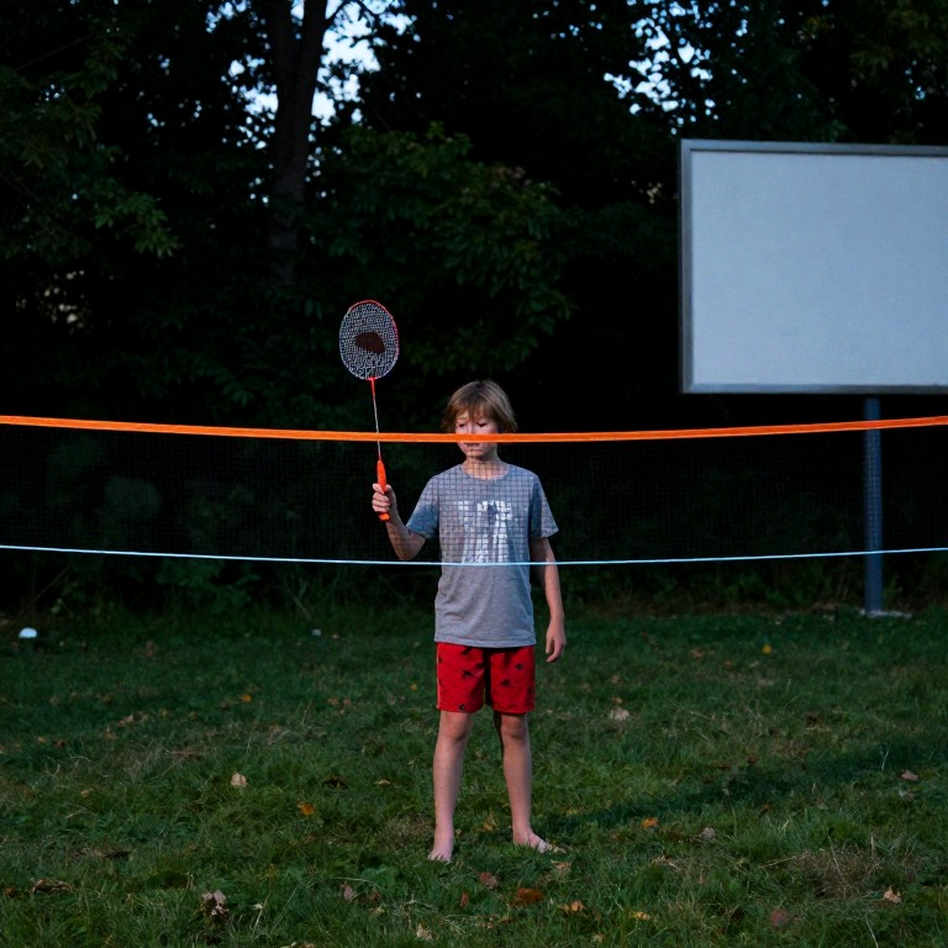
The tournament gathers more than 300 players from 27 countries and territories. That figure sounds large, and it genuinely is for a regional event — but it must be read correctly: volume does not equal elite quality. A tournament with three hundred entrants and a tournament with the three hundred best are two entirely different stories. At the Vietnam Open, top Asian seeds are almost absent. What remains is a competitive floor where experience can sometimes outweigh physical capacity.
That context matters because it decides how we should read Nguyễn Tiến Minh's result. At a Super 1000, a 254th-ranked player clearing qualifying is ordinary. At a Super 100, it is also ordinary — but for a different reason: the opponent floor is lower, and the gap between a former star and a doubles specialist is no longer an abyss.
Vietnam's men's singles draw this time has a particular shape. Beyond Tiến Minh, the team includes Lê Đức Phát — struggling with knee and heel injuries and requiring pain-relief medication — and Nguyễn Hải Đăng, who lost his match. Nguyễn Hoàng Thái Sơn, Tiến Minh's qualifying opponent, is by background a doubles player. This is a men's singles group in transition: a veteran, an injured player, one who has just exited, and a doubles specialist pushed onto the singles court.
On the women's side the picture is somewhat brighter, with Nguyễn Thùy Linh facing a 19-year-old opponent. The contrast between the two sides — a men's singles leaning on age and experience, a women's singles leaning on youth — is worth pausing over when considering how Vietnamese badminton allocates its resources.
Reading the match: a win built on opportunity, not superiority
First, I must be explicit: technically, we have almost no data. No one published average smash speed, rally length, or unforced-error rate. What remains is Tiến Minh's own description: he said his opponent was "not strong in singles" but had "strength and speed."
I read that line several times, because it contains nearly the entire tactical story. When a player says his opponent is not strong in singles, he is saying something far more specific than it appears. In badminton, doubles and singles are two distinct movement systems. Doubles players are accustomed to fast tempo, to sharing court zones, to short and decisive net exchanges. Singles players live on endurance, on the ability to move laterally and longitudinally through a long game, on the capacity to endure extended rallies without erroring.
When a doubles player steps onto a singles court, he brings strength and speed — exactly as Tiến Minh described — but usually also incompatible habits: choosing the attacking option too early, hitting by doubles-court instinct, and above all lacking patience in extended rallies. That is fertile ground for a veteran singles player who has played thousands of matches and knows precisely when to let the opponent self-destruct.
So this victory carries the shape of a win built on exploiting weakness rather than one built on technical dominance. I infer Tiến Minh chose deep-court placements, forcing his opponent to move longitudinally — something a doubles player rarely does continuously — and then waited. Waited for youthful speed to turn into haste, and haste into error. That is an inference with grounds, not a firm conclusion, because I have no detailed footage to verify each rally.
And here I must remind myself. A win over a player who is not a singles specialist says nothing about the winner's top-level form. It only says that in a specific match, between two specific people, one understood better than the other what should be done.
The number 254 and the age curve
At 43, holding 254th in the world is respectable — but it must be placed in its proper context. This is the final stage of a career. At this age, reflexes slow, recovery after each match declines, and stamina across three games becomes a variable no training volume fully offsets. Experience can substitute for part of it, but only part.
What Tiến Minh has, and what rankings cannot measure, is familiarity with pressure. He has stood on far bigger courts, against far stronger opponents. In a Super 100 qualifying match, most young opponents have never felt that. That psychological distance is an invisible score, and it often decides the rallies at the end of a game.
But I do not want to paint too pretty a picture. A qualifying win is only one data sample, and small samples are always a trap. If Tiến Minh loses in the main draw next week, the story flips instantly and people will forget they once praised him. The numbers are not wrong; I simply forgot to ask where they were standing.
Second, remember that Super 100 offers very few ranking points. For a 254th-ranked player, clearing qualifying produces no leap on the world rankings. This is an incremental step, not a milestone. People in the trade call it "point-hunting" — and the label is accurate, because that is what it is.
Regional stage: Vietnam's team at a low-tier event
Broadly, Vietnam's picture at the Vietnam Open 2026 reflects a structural reality. After qualifying, Tiến Minh enters the main draw to face Zhe Ying Wu. In another branch, Lê Đức Phát carries knee and heel injuries, using pain relief to keep competing, with his wife in the stands. Nguyễn Hải Đăng exited after defeat. And in women's singles, Nguyễn Thùy Linh faces a 19-year-old opponent.
Placed side by side, these lines form what I call a "transitional group." A veteran holding a position the younger generation has not yet taken. An injured player trying to maintain presence. A young player who has just lost. And a doubles specialist pushed onto the singles court — a sign that men's singles resources are thin.
This is not a judgment on individual effort. It is reading structure. When a team must send a doubles player into men's singles qualifying, that is not a tactical choice — it is the consequence of limited squad depth. And when your most prominent men's singles player is still the 43-year-old, the problem is not that 43-year-old; the problem is the gap behind him.
There is a hypothesis I have tracked for a while: Vietnamese badminton may be prioritizing doubles development over singles. It is a hypothesis, not a conclusion — I lack the data to assert it. But the squad structure at this event signals in that direction, and weak signals are often more trustworthy than strong statements.
Notably, the international floor here is not intimidating either. No top Asian seeds. No players from the largest badminton centres. There are regional players such as Singapore's Jia Wei Joel Koh, also hunting points and experience. This is a stage where results say little about Vietnamese badminton's standing on the world map.
The contrarian angle: the trap of a single win
This is the section I want to spend the most time on, because it is where data and intuition collide.
After a win like Tiến Minh's, the story writes itself along a familiar groove: "a 43-year-old veteran still burning bright," "experience beats youth," "a sportsmanship story worth admiring." I do not deny those lines. But I want to separate them from analysis, because they are the language that blurs what is actually happening.
The right question is not "Does Tiến Minh still have enough in the tank?" The right question is: "What does this win correlate with?" It correlates with an opponent who is not a professional singles player, with the low opponent floor of a Super 100 event, with most strong Asian players absent. Correlation is not causation. A win does not prove capability, just as a number does not prove a truth. It is only a point on a curve, and the curve is what matters.
The second trap lies on the public side. We tend to read results as moral tales. A 43-year-old beats a young player, and instantly the story becomes a hymn to age and will. But in badminton, age is a variable with its own equation: it affects recovery, stamina in a third game, lateral movement speed. A qualifying win does not refute that equation; it merely shows the equation has not yet been tested.
The third trap is one I have fallen into myself, and I want to say it plainly. In 2026, I was absorbed by one team's tactical story at the World Cup, spending two weeks writing only about them and ignoring parallel developments. When that team was eliminated, I realized I had missed personnel changes at another team — changes I should have seen. Since then I set a rule: no more than three hours a day per topic, the rest for what is happening around it. With the Vietnam Open 2026, I force myself to do the same. If I looked only at Tiến Minh's win, I would miss Lê Đức Phát's injury, Nguyễn Hải Đăng's defeat, and the fact that a doubles player had to play singles. Those pieces matter more than a single result.
There is another aspect I always consider but rarely write about. When we discuss the digitalization of sport, we usually discuss conveniences: data enables better analysis, helps viewers understand matches. But there is a rarely mentioned side effect: this data, in its rawest and fastest form, often flows directly to betting companies. A Super 100 qualifying match with a few result lines can become raw material for odds tables updated by the minute. For someone who reads data professionally, this is why I am always careful with every number I publish — because I do not control where it goes after leaving my article.
What I missed
I want a short paragraph to acknowledge what this analysis does not include. I have no detailed footage to assess specific rallies. I do not know the court conditions, wind direction, or lighting — things I have previously shown genuinely affect player movement metrics. I do not know Tiến Minh's exact schedule in the coming days, nor how he recovers from qualifying. And I do not know the true severity of Lê Đức Phát's injury, beyond the fact that he requires pain relief.
Stating these gaps does not weaken the analysis. It makes it more honest. Only when the court falls silent do I hear the underlying data's whisper clearly. And in this case, the whisper says: wait a little longer.
Signals for the next round
Tiến Minh enters the main draw against Zhe Ying Wu. This will be the first real test, because qualifying and the main draw are different floors. If he sustains his movement and patience across long rallies, that is a positive signal. If he loses quickly in extended games, that is a signal about the age curve we discussed at the start.
For Lê Đức Phát, what matters is not the result but whether he needs pain relief again. A knee and heel injury at his peak age is a variable heavier than any ranking. If it recurs, withdrawal risk at subsequent events rises, directly affecting the national team structure.
For Nguyễn Thùy Linh in women's singles, facing a 19-year-old is a tempo test. Young opponents usually have better speed but lack experience in decisive rallies. How a seasoned player handles those rallies will say much about her regional standing.
Above all, what I will track is not a specific result but a pattern. Across the next three to five Super 100 events, if more young Vietnamese players appear in main draws, that is a positive structural signal. If only the same old names remain, then Tiến Minh's win today will stay a beautiful story rather than a turning point.
Closing
I once thought data was truth, until a major tournament taught me fear. Now, whenever a number appears — whether it is age 43, ranking 254, or a "won" line on a results sheet — I ask it one question: where are you standing? For Nguyễn Tiến Minh's win at the Vietnam Open 2026, the answer is: in a Super 100 qualifying round, against a doubles player who is not a singles specialist, at an event where most strong Asian players did not come. That is an honest answer, and it is just enough to respect the effort of a 43-year-old man, and just enough not to mistake it for a larger truth.
What I want to leave here is not a conclusion about Tiến Minh. It is a habit: when you read any result, ask where it is standing. A number removed from context is only a lie made beautiful. And in a sport where each rally lasts only seconds, that habit is all we truly have.
